Video Learning: Parent-Infant Musical Interactions
Amy Smith, PhD, MT-BC; Fiona Higgins, MS, CCC-SLP
January 28, 2026
https://serenademusicclass.org/video-learning-parent-infant-musical-interactions/
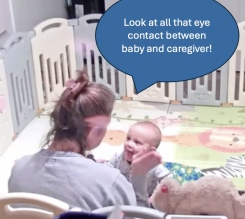
What do Parents, Babies, and Toddlers Do Together During Musical Interactions? Researchers observe and code parents and children during play to learn about the impacts of musical experiences on parent-child interactions. See if you can notice behaviors related to movements, facial expressions, attention, and vocalizations as you watch the video and learn more!https://serenademusicclass.org/video-learning-parent-infant-musical-int…;
InCHORRRuS: Infant-Directed Communication Highlights and Organizes Repetition and Redundancy Through Rhythmic Structure
Camila Alviar, Warren Jones, Miriam Lense
January 21, 2026
https://nyaspubs.onlinelibrary.wiley.com/doi/full/10.1111/nyas.70147
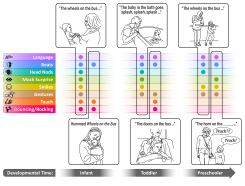
In the InCHORRRuS (Infant-directed (ID) Communication Highlights and Organizes Repetition and Redundancy through Rhythmic Structure) framework, increased rhythmicity in ID speech and the beat-based metrically structured rhythmicity in ID song naturally organize the multimodally redundant and repetitive cues in the caregiver's communicative signals, supercharging their saliency by increasing their predictability. Rhythmicity naturally modulates infant attention, guiding it to those communicatively rich times and scaffolding caregiver-infant coordination.
Music and Parental Wellbeing: A Position Paper
The Music and Parental Wellbeing Research Network
January 21, 2026
https://journals.sagepub.com/doi/full/10.1177/20592043251351761
Parental Social and Musical Characteristics, the Home Music Environment, and Child Language Development in Infancy
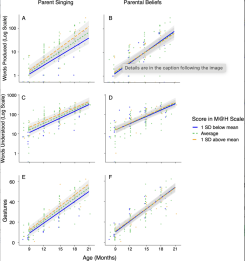
Ashley Boyne, Camila Alviar, and Miriam Lense
January 21, 2026
https://onlinelibrary.wiley.com/doi/full/10.1111/infa.70008
ABSTRACT Parents use music, especially singing, to interact with their young children, supporting parent-child bonding and social communication. Little is known about the parental attributes that support musical interactions with their infants. In this exploratory study, we analyzed self-report data from 43 caregiver/infant dyads at up to four time points (9, 12, 15, and 18 months) to assess parent social motivation and musical training as predictors of the home music environment overall, parental singing, and parental beliefs in the benefits of music.
Storytime with the Nashville Symphony
June 2, 2023
On April 1st, in conjunction with the Nashville Symphony, the Vanderbilt Music Cognition lab hosted an interactive music and storytelling event for local families: Storytime with the Nashville Symphony.
Mindful Songwriting: Songs from Parents/Caregivers
November 17, 2022
In our Mindfulness-Based Music and Songwriting study, caregivers/parents of children with developmental disabilities learned and applied mindfulness principles through the practice of creating original songs about their children and themselves. Songwriting focused on applying mindfulness principles such as paying attention without judgment and loving kindness.All songs are shared with participant permission.Mindfulness / Mindful Songwriting Information
Integrated Parent-Child Music Classes for Preschoolers with and without ASD: Parent Expectations and Experiences
Lense M, Liu T, Booke L, Crawley Z, Beck S
July 26, 2022
https://nyaspubs.onlinelibrary.wiley.com/doi/full/10.1111/nyas.14875?casa_token=ue8qlmlWOz0AAAAA%3A717M55qUiY_6B8uB2dYew5F8TWPk0hqkfVVBL7U6hF7DOBfMOCKtmcv0CJcCJ67FoAIA7fzcgaPUwHlY
Integrated recreational programs designed to support neurodiverse children and their families are important vehicles for community participation. In this mixed-methods study, we investigated the mechanisms by which parent-child music classes for autistic and neurotypical children can support community participation. Parents of autistic (n=33) and typically developing (TD; n=28) preschoolers were interviewed about their expectations for and experiences of participating in a 12-week psychoeducational parent-child music program.
ACM Tempo Magazine: Music Mends
Libby Gardner (interview with Miriam Lense, p. 22, 24)
https://issuu.com/acm_pubs/docs/temposp22_whole/22
Academy of Country Music Tempo Magazine, Spring 2022 issue: Vanderbilt’s Music Cognition Lab Co-Director, Dr. Miriam Lense, highlights the research and valuable programs her team is working on to help uncover the benefits of using music for healing.
Parent-child nonverbal engagement during read versus sung book-sharing in preschoolers with and without ASD
Talia Liu
January 8, 2022
https://doi.org/10.1177/03057356211058781
Providing natural opportunities that scaffold interpersonal engagement is important for supporting social interactions for young children with autism spectrum disorder (ASD). Musical activities are often motivating, familiar, and predictable, and may support both children and their interaction partners by providing opportunities for shared social engagement.