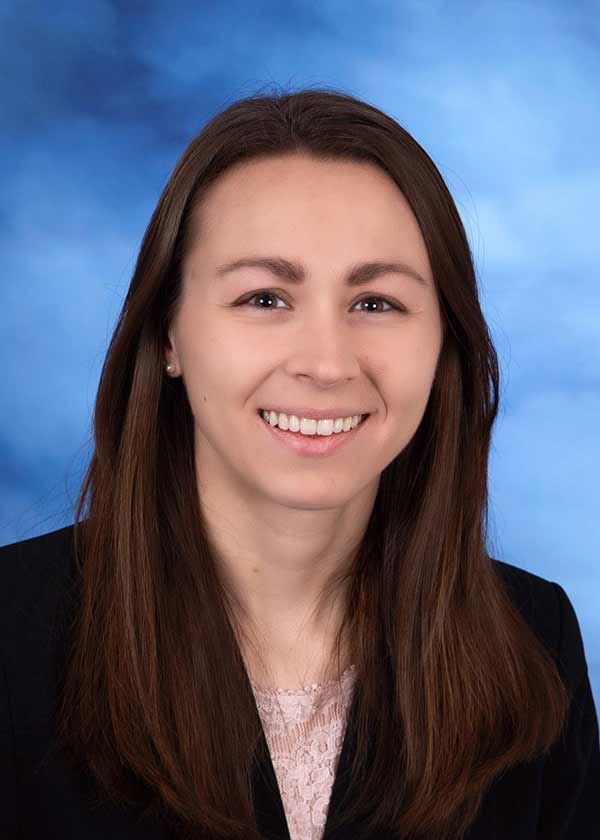
Resident Spotlight
Lauren Osborne, MD
Growing up with parents in the medical field, Dr. Lauren Osborne knew she wanted to pursue medicine from an early age. She has always appreciated long-term relationships between doctors and patients, and soon discovered that neurology offered the opportunity to care for patients over time while also exploring interesting disease pathology. Dr. Osborne has earned a reputation for her baking skills, often sharing her creations with her colleagues.
Tell us about your background.
I was born and raised in South Bend, Indiana. My mom was a nurse and my dad was an internal medicine and primary care doctor, so I knew early on that I wanted to go into medicine as well. For college, I wanted to experience a bigger city away from the college town I’d grown up in, and ended up at Creighton University in Omaha, Nebraska. I really loved it there and met my husband there as well. I then came back to Indiana for medical school as I really couldn’t pass up the in-state tuition! I did medical school at Indiana University, which has several regional campuses so I was lucky enough to be able to live at home with my parents for my first two years in my hometown of South Bend. I got married between my second and third year of medical school, however this was right as the COVID pandemic was starting, so we had a small COVID wedding and I moved to where my now-husband was in Indianapolis for my two clinical years of medical school. Finally, we came down south for the first time for residency at Vanderbilt.
What attracted you to VUMC for residency?
I was open to going just about anywhere for residency, with some conditions. I still wanted to be somewhat close to where I grew up. More than that, I was looking for a place where I could tell people were nice and working in a collaborative environment. I could tell from my interview that Vanderbilt had that. Everyone I met here was so down to earth and wanted to get to know me. There was no pressure; no one was judging me in any way, and I didn’t feel like I needed to fit a certain mold to belong here. I really liked the overall sense of community they promote and develop. I also wanted a place that would expose me to everything I needed to see as a neurologist. Vanderbilt has both of those criteria–a good working environment plus being a huge catchment area for such a wide radius and patient population. We see a good amount of interesting pathology, which was important to me in choosing a residency.
What piqued your interest in neurology?
I thought for a long time, even about halfway through medical school, that I wanted to be a primary care doctor. I really valued the relationships doctors build with their patients over time. I initially thought that to do that, you had to be in primary care in order to see patients over and over again and get to know them. In medical school, as I was exposed to more subspecialities, I really loved learning about the diseases that neurology cares for as well as that close link to neuroanatomy. I felt like every new patient was a puzzle to understand. But also in neurology we treat many diseases that require a long continuity of care, such as Parkinson’s, multiple sclerosis, dementia, and headaches. I learned that doctors can enjoy long-term relationships with patients outside of just primary care. I thought neurology was the best of both worlds, so to speak, in that there were the diseases and patients that I wanted to learn more about, while also offering the opportunity to care for patients in the long-term in the clinic, which was really rewarding for me.
The other piece of my interest in neurology is that a genetic neurologic disorder called Huntington’s disease affects my dad’s side of the family. I think early exposure to that in my childhood also played into my desire to take care of people through difficult diseases. Even if we don’t have cures for those diseases, those patients still need good doctors who will care for them throughout their course.
What have been some highlights of residency so far?
Now that I’m toward the end of it, I’m starting to get reflective. Looking back and seeing the growth I’ve made has been rewarding. Just last month I was on an overnight shift, and there were two or three patients I saw that had really subtle findings in their exams. I was able to pick up on those and localize the lesion. I recognized it, made the right diagnosis and the right plan all on my own. I don’t think I would have been able to do that two or three years ago. That was a really nice moment to see myself coming full circle as a neurologist.
We also have a really amazing group of residents and faculty that we work with. There have been many times when I’ve had such positive interactions with attendings, whether I’m asking them questions and they’re teaching me, or I made a correct diagnosis like I had last month and they’re congratulating me.
What have been some of the more challenging aspects of residency? What helps you meet those challenges?
I think the main challenge is the time constraint and the overall busyness of it. You can always log into the EHR online to see how your patients are doing or check a test result, so the demanding number of hours is what makes it challenging. For me, having my own personal support system helps. My husband is the best; he’s the one who I want to come home and talk about my day with, and the same with the rest of my family. Our residency family is also a solid support to fall back on with people who understand the same demands, so it can be nice to vent with them a little when needed.
Who have been some important mentors for you so far, either in your career or in life?
In life I definitely think of my dad. He’s retired now, but he knows the demands of being in medicine. It was really fun to live with my parents during medical school because he would come home and ask me what I learned that day, talk to me about his patients, and walk through patient scenarios with me. He has helped instill in me the important fact that we’re always learning in medicine.
Here at Vanderbilt, several faculty members in the movement disorders division have been helpful for me. Dr. Girithiran was my continuity clinic attending in my first neurology year and he has helped guide me as I continued on my path to movement disorders. Dr. Taylor in the neuroimmunology division is also great and has been a mentor for a lot of our female residents as she is a big proponent for health and wellness as well as family life outside of residency.
What are your plans post-residency?
I will be the Movement Disorders Fellow here at Vanderbilt next year. I’m excited for the year of fellowship to focus on advanced therapies for bread-and-butter movement disorders like Parkinson’s as well as more niche and rare diseases. We have a really great Huntington’s clinic here, so I’m excited to work in that clinic and with those patients more as well.
Are you leaning toward being more of a clinician, or do you have any interest in pursuing education or research?
Outpatient clinic has always been my favorite and how I’d like to spend the majority of my time as a clinician. Because I like working with the Huntington’s disease patient population, I would want to work somewhere with a clinic dedicated to that. During fellowship I may try to dip my toes into Huntington’s research as it is such an exciting time in trying to find therapies for such a devastating disease.
What hobbies or interests do you have outside of work?
I love to run and even ran my first marathon last year. That was really hard to train for during residency but rewarding! I also bake a lot; all the residents know that and love when I bring in treats to share. I love a good crossword puzzle and dabble in knitting here and there. Otherwise I like to relax with my husband and our two cats.
Do you have a go-to recipe that is a favorite of your co-residents?
I like to make French macarons, so that’s definitely what all the residents know me for. I make those a couple times a year in different flavors.