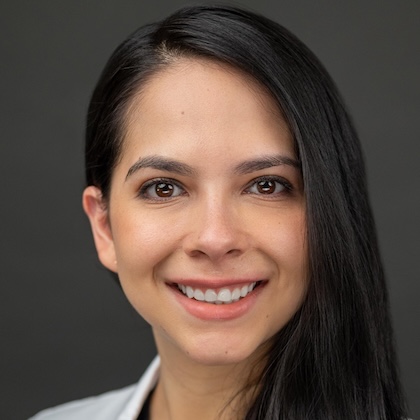
Dr. Laura Dresser
Assistant Professor of Neurology
Born and raised in Colombia, Dr. Dresser completed two fellowships and worked in private practice before beginning as a faculty member at Vanderbilt in 2025. She enjoys following her patients over time, which allows her to see the impact of her day to day work. In her free time, you’ll find her and her husband exploring Nashville’s many parks with their young daughter.
Tell us about your background and how your path led to Vanderbilt.
I’m originally from Colombia. I was born and raised there, and lived there until I was in my mid-20s when I moved to the U.S. to start residency. I did medical school training at the Universidad del Rosario in Bogota back home in Colombia. Then I came here and lived in Boston for about two years while I did some research at Harvard. After that I moved to Chicago to do my intern year, residency, and first fellowship. I then moved to the University of Pittsburgh for a year for a second fellowship. I then moved with my husband (who is also a doctor) to Florida and worked in private practice for three years before moving here to Vanderbilt.
What did your fellowship trainings focus on?
I completed two fellowships. The first is in Multiple Sclerosis (MS) and Neuroimmunology. The second is in Women’s Neurology, which focuses on issues like managing pregnancy, post-partum and pregnancy planning in women with other neurological diagnoses.
What made you interested in neurology?
I think my interest in medicine was related to my family’s background. My father had diabetes from a young age. He experienced a lot of medical complications and we were very involved in his care. That initially sparked my interest. I found myself more inclined towards the sciences while growing up, so through that I developed a big interest in medicine. One of my primary mentors in medical school was a psychiatrist, so much of my research at that time was related to psychiatry and neurology, which sparked my initial interest in neurology. My research after that leaned toward neuroscience. I started pursuing neurology residency not knowing that I wanted to focus on MS, so I dabbled in many subspecialties.
But a lot of the new advancements emerging when I was in training were related to MS, so that was one reason I became very interested in neuroimmunology. I also liked that you could make a big impact in the lives of patients with MS by intervening early in the progression of the disease.
What attracted you to Vanderbilt?
My husband and I had both trained in big academic centers and we missed that aspect of medicine, having the backing of a bigger system and multiple specialities to rely on with more complex cases. In private practice you get a little bit of everything in terms of the kinds of cases you see, but it also means you can’t communicate as easily with other specialists, and it seemed like the care was more fragmented.
We also knew we wanted to stay toward the South, and Vanderbilt is a great institution. One of my attendings from residency now works in the Neurology Department here and had so many great things to say about Vanderbilt.
What are some of the most rewarding aspects of your job?
In Neuroimmunology we get to establish pretty long-lasting relationships with our patients. You get to see them for several years. You get to know them and see the good impact from your day to day work in the plans you make or treatments you offer them.
What do you consider to be some of the challenges?
What is hard in neurology is that you can have patients with very complex symptoms without a clear explanation, which can be very frustrating for the patients, as well as for me, that we don’t always have a straight answer. Additionally, medicine is getting more complex, and it’s getting harder to navigate the bureaucratic system. It’s frustrating but it’s also the reality of medicine these days.
Who have been some important mentors for you along the way?
In medical school I worked very closely with a psychologist named Ricardo Jamin. I worked in both clinical and research areas with him. He helped me think more critically about medicine but also about life in general, because in psychiatry you deal with a lot of real life. That experience really opened my perspective about the human mind and how human emotions drive so much of what we experience. He also is just a good person and mentor about how to conduct yourself in medicine.
I did research for a while with Felipe Fregni in Boston. He was also a neurologist and an excellent researcher with a great science and business mind.
In residency I worked with the program director of my residency, Helene Rubeiz. She was a very good critical thinker and very organized, and that has helped me in my practice. She helped me understand how you see a patient and structure an interview, but also how to document it so that others can understand your thinking.
What are your impressions of Nashville so far?
We love it. In Florida I missed rolling hills. I grew up in a place with a lot of hills so I love the nature here, the geography. It’s a beautiful city. I think in the time and area I’ve lived in, it’s not overwhelmingly busy, I’m not being drowned in traffic. Culturally, it’s not the most cosmopolitan city I've lived in, but there is a lot of culture here and I like that.
I live near Cheekwood and we love going there frequently. It’s such a beautiful area with lots of parks. Every weekend we could go to a different park with my daughter, and they are all so nice and have so many things to do.
How do you like to spend your free time?
A lot of my time is spent with my daughter. We are constantly trying to get outside for parks and activities for her and things we can do as a family. When I have the time, my other hobby is reading. Right now I listen to a lot of audiobooks because I can do it when I'm driving when I don't have much time. I like to read a little bit of everything–mostly fiction, but I like everything.
What are you currently reading?
I’ve recently been going through Isabel Allende’s books. She has so many beautiful books and they tend to follow each other so it’s best to read them all at one time.
Who or what inspires you?
I would say my sister and my mother. Both are hardworking, strong women. My sister has a young child with a disability, but despite that she’s created a beautiful career and lives a healthy, well-rounded lifestyle. So I guess I receive inspiration from women in my family who have shown me the way.