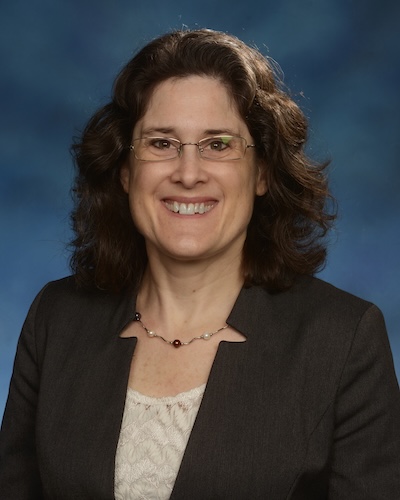
Dr. Carolyn Cronin joined the neurology faculty in February 2025 as both the Division Chief for Vascular Neurology and the Vice Chair of Education. Prior to her move to Vanderbilt, Dr. Cronin spent 15 years at the University of Maryland, where she discovered a love of educational and administrative work, which was a bit of a shift from her initial focus on research. When she’s not mentoring trainees, she enjoys exploring her new neighborhood, walking, and knitting.
Tell us a bit about your background. What did your career look like prior to starting at Vanderbilt, and how did your path land here?
I grew up in a suburb of Boston called Newton. I stayed there for college and attended Boston College. I then went on to the University of Virginia for the Medical Science Training Program (MSTP), which is a combined MD/PhD program. Growing up and throughout school, I really enjoyed science and investigating things, but I was also really drawn to medicine, so the dual program was very appealing. I really enjoyed my PhD in neuroscience, which was focused very much on basic science such as genetics, molecular biology, mouse models, and neuronal pathfinding.
I met my husband while there at University of Virginia–he was also in the neuroscience graduate program. We got married, and we had our twins toward the end of that program. In fact, they were born right after I finished the last clinical rotation of medical school that I had to do. I took a year between medical school and my internship year to be home with them, which was really fun. I stayed at UV for my internship, and then we moved outside of Baltimore for me to do my neurology residency at Johns Hopkins.
When I started residency, I was planning to go the traditional MD/PhD path of returning to basic science in terms of having my own lab. But what I came to realize during residency was that I really liked the clinical part, and I wanted that to be the majority of my time. So I shifted gears toward thinking about clinical research and how I would be able to integrate that into my career to keep that research part of it while also pursuing a clinical route.
After residency, I went on to the University of Maryland for a fellowship in vascular neurology. It was a great clinical program with lots of clinical research going on. I stayed on at Maryland as faculty starting in 2009 until moving to Vanderbilt in 2025.
What were some of the highlights of your 15 years at the University of Maryland?
From a research standpoint, I wrote a grant during my fellowship for a small study through the American Heart Association, so I worked on that early on, looking at patients treated with thrombolytics among multiple sites in Maryland. Subsequently, I was the local Primary Investigator (PI) and co-investigator at our site for various studies, as we were involved in many multi-center clinical trials in stroke.
The majority of my job at Maryland was working as a stroke neurologist and medical educator. I had always enjoyed teaching and became more involved with that as well as some of the more administrative aspects of education. A couple of years into my time there, I took over as the Director of the Vascular Neurology Fellowship. A few years later I was asked to be the residency program director as well. I was in both of those roles for many years, then in the last couple years I was there someone else took over the fellowship program. I continued to be residency program director and also took on the role of vice chair of education. I have enjoyed working closely with residents and fellows, directing training, and learning how to mentor people, to help meet them where they are and figure out what support they need, which is different for everyone.
What attracted you to Vanderbilt?
I wasn’t looking to change jobs. One of my former fellows, Dr. Lisa Hermann, is on faculty here. She had reached out to me initially in 2021 when the prior division director (Dr. Howard Kirshner) was thinking of retiring, and asked if I was interested in the position. At that point my twins had just started their freshman year of college. Both had chosen University of Maryland, College Park, in order to be close to home. At that time, I didn’t think I could entertain moving to a new area because of those personal reasons. Then in the spring of 2024, Lisa reached out to me again because the interim director, Dr. Derek Riebau, didn’t want to keep doing the job long term. The position was still open, so she asked again if I would think about it. At that point my kids were in a good place and doing their own thing, so I started actually thinking about it.
What attracted me was the opportunity to be the division director and help guide stroke care at a major academic center. I came to Vanderbilt for the interview and got a really good feeling about the place in terms of the people here and the leadership. It seemed very collaborative, and the leadership was open, fair, and transparent about things. It seemed like a place that was genuinely interested in providing the best care for the patients and also supporting the well-being of the people who worked here. I feel like those are two things that are really important in medicine these days and you don’t always get both.
Tell us a bit about the administrative aspects of your job. What do you enjoy about your role as Division Chief and Vice Chair of Education? Are you still engaged in any research activities?
I was happy to get the offer from Vanderbilt to also be the Vice Chair of Education because that had been a big part of my career, directing the educational programs. Both of my roles (Division Chief and Vice Chair of Education) combine a lot of the administrative aspects I enjoy and think I'm pretty good at, such as organizing, troubleshooting, problem solving, and thinking about systems and how to improve them. Also, another big aspect of both roles is mentoring, teaching, and supporting trainees and faculty in their careers. I enjoy doing those things.
Currently half of my time is clinical service–a combination of inpatient stroke service, taking acute stroke calls and managing patients in the hospital, and an outpatient stroke clinic. I enjoy both of those. The outpatient is less popular these days. Many people coming out of training just want to do the inpatient side. But I enjoy seeing people at the onset of a stroke and using the treatments we have to reverse stroke symptoms, then being able to follow up with a patient and see their symptoms evolve and help them with things that can come up after a stroke. There’s also an aspect of preventative medicine involved especially in the outpatient clinic, which involves a lot of patient education, which comes back to that education piece that I enjoy.
On the research side of things, here at Vanderbilt, I’m basically looking to expand and optimize the clinical research program by getting us involved in more multi-center trials similar to those I was involved with at Maryland.
What are some of the current challenges you face as a physician? What helps you meet those challenges?
I think one of the challenges all clinicians face these days is having time with patients (which is what most physicians enjoy about the job) while also managing the interface with the electronic medical record and documenting. I have started using the DAX Copilot in my clinic to help create the note, and I have found it really helpful in cutting down on my documentation time and being able to be more focused during the appointment. You have to play with the settings a bit to get the output that will work for you, but it’s worth doing. That’s an aspect of modern medicine that most people are struggling with.
From an administrative standpoint, one of the things that can frequently happen is that people become siloed in their own interests, activities, and spaces; more communication and collaboration is always helpful. I’ve been trying to foster that in both of my roles, in getting more people together in the room.
What advice do you like to share with trainees?
When I’m working with early trainees (such as medical students or residents), I let them know that there’s a spectrum of efficiency and completeness. Some people are way on one side or the other of that, and you need to somehow find a balance and set up the systems and strategies that will help you not neglect either of those things. For faculty and more career or administrative advice, it’s helping people figure out what they want to do and what they’re good at, as opposed to what they think they should be doing.
What has been your impression of Nashville so far? What have been some of your favorite spots (restaurants, parks, etc)?
I’ve really enjoyed Nashville. The transition for me was not just to a new city, but also from living in the suburbs to living in the city. We currently live in the Belmont/Hillsboro neighborhood, and we spend a lot of time just walking around the neighborhood. We are walking distance to 12 South, which has been fun and convenient to be spontaneously out on a walk and decide to get dinner. We’ve enjoyed lots of the restaurants in that area.
What are some of your interests and hobbies outside of work?
We also like hiking and getting out in nature. We’ve been to Radnor Lake a few times and that’s really lovely. We want to explore more hiking in the area. My main hobby in addition to walking is knitting. It’s both relaxing and can also be a fun challenge to create more complex things and learn new techniques.