Team to test app for improving HIV care for new mothers in South Africa

South Africa has more HIV/AIDS patients than any other country and is home to the world’s largest antiretroviral program. According to the World Bank, as of 2018 the prevalence of HIV among South Africans ages 15 to 49 was 20.4%. Nearly one in three pregnant women attending antenatal care in South Africa is living with HIV. As South Africans with HIV move around the country, there is a risk they will disengage from the health care system or otherwise become lost to follow-up care.

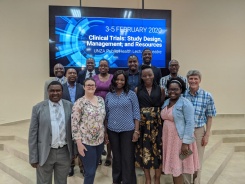
Clinical Trials Workshop in Zambia Lead by VUMC and University of Zambia Draws Almost 200 Participants

The NIH-Fogarty supported UNZA-Vanderbilt Training Partnership for HIV-Nutrition-Metabolic Research (UVP) continues a multi-decade training collaboration between the University of Zambia School of Medicine/University Teaching Hospital (UNZA/UTH) and the Vanderbilt Institute for Global Health (VIGH).

Lizet Tirres, MS, MBA

Lizet
Tirres
M.S., MBA
Data Manager
2525 West End Ave, Suite 750
Nashville
Tennessee
37203

Bridging the Gap in Global Epilepsy Treatment

The Vanderbilt Institute for Global Health (VIGH) has partnered with Aminu Kano Teaching Hospital (AKTH) in Kano, Nigeria to improve epilepsy treatment uptake. The groups will conduct a randomized trial in three cities in northern Nigeria to determine the efficacy of shifting epilepsy care to community health workers.

UVP Program Update

The University of Zambia (UNZA)-Vanderbilt Training Partnership for HIV-Nutrition-Metabolic Research (UVP) made substantial progress on its goals of training new UNZA PhD scientists to investigate complex nutritional and metabolic factors related to long-term HIV complications and comorbidities. The paper entitled, "HIV Research Training Partnership of the University of Zambia and Vanderbilt University: Features and Early Outcomes," was recently published in Annuals of Global Health.

Margaret Tarpley, MLS

Margaret
Tarpley
MLS
Adjunct Instructor
Department of Surgery, Vanderbilt University School of Medicine
Adjunct Lecturer
Department of Medical Education, University of Botswana
margaret.tarpley@vanderbilt.edu

Global Health Research Interests: Biomedical Ethics, Education and Training (Capacity Building), Medical Education

Countries: Botswana, Kenya

Mrs. Tarpley is an adjunct instructor in the Department of Surgery at Vanderbilt University Medical Center and a medical education lecturer at the University of Botswana. After 15 years as a theological librarian in Nigeria, she spent 15 years in the Department of Surgery at Vanderbilt, working with general surgery residents and medical students. Her current focus is on medical education and medical journal editing. She has worked in Kenya, Rwanda and Botswana. Mrs. Tarpley’s research interests are surgery education and cultural competence in medicine and health care delivery.

Mrs. Tarpley earned her bachelor’s degree in English from Vanderbilt University and a master’s in Library Science from Peabody College.

Roy Zent, MD, PhD

Roy
Zent
M.D., PhD
Thomas F. Frist Sr. Professor of Medicine
Department of Medicine, Vanderbilt University Medical Center

Roy Zent, MD, is the Thomas F. Frist Sr. Professor of Medicine at the Vanderbilt University School of Medicine. He is a member of the division of nephrology, the Vice Chair of Research for the Department of Medicine, and a professor in Cell and Developmental Biology and Cancer Biology. He received medical training at The University of Witwatersrand in Johannesburg, South Africa, and specialized in internal medicine and nephrology at the University of Cape Town. Dr. Zent received a Ph.D in cell biology from the University of Toronto in Canada and did a post-doctoral fellowship with Dr. Mark Ginsberg at The Scripps Research Institute in La Jolla, CA. He is board-certified in internal medicine and nephrology in South Africa, Canada, and the U.S. 

The main research focus of the Zent group is to define mechanisms of cell-extracellular matrix interactions and how they affect kidney development and function. The family of proteins focused on is called integrins, which are the principal cell receptors for extracellular matrix. The major projects in the group include: 1) defining the mechanisms whereby integrins regulate cell function and signaling; 2) defining how integrin cytoplasmic tails interact with cytoplasmic proteins to regulate cell function; 3) defining the structural determinants of specificity of integrin-dependent signaling. The primary techniques to answer these questions include the making and characterizing transgenic mice, cell biology and biochemical techniques, and structural methodologies, including 3-dimensional nuclear magnetic resonance. Our group has extensive collaborations with other groups within the division of nephrology and other departments at Vanderbilt Medical Center.    

roy.zent@vumc.org
zentroy
Lloyd Mulenga, PhD, MMed, MBChB, MSc

Lloyd
Mulenga
MBCHB, MSc, MMED, PhD
National HIV Program Coordinator
Ministry of Health, Zambia
Associate Director of Infectious Diseases
University of Zambia School of Medicine
Adjunct Assistant Professor
Department of Medicine

Lloyd Mulenga, PhD, MMed, MBChB, MSc is an Infectious Disease and Internal Medicine Specialist, practicing at the University Teaching Hospital, in Lusaka, Zambia and the Director of Infectious Diseases for the Ministry of Health. He is the lead infectious diseases physician for the Zambian COVID-19 clinical response. He currently serves on the United States National Institute of Health (NIH) Data and Safety Monitoring Boards for the Division of AIDS National Institute of Allergy and Infectious Diseases (NIAID), the WHO Guidelines Development Group and the WHO HIV Drug Resistance Network (HIVResNet). His research focuses on HIV and clinical outcomes and drug resistance, HIV and non-communicable diseases (kidney, cardiovascular and diabetes) and infectious diseases epidemiology and clinical outcomes including SARS-CoV-2, tuberculosis and hepatitis. 

As a physician-scientist-policymaker, Dr. Mulenga leads infectious disease activities at the University of Zambia, in the university’s teaching hospital and lab, as well as within his country’s health ministry. In addition to conducting research and publishing in nearly 50 journals, he also has engaged in science diplomacy, delivered a plenary presentation on the state of HIV in Africa at the U.N., and participated in a WHO review of the agency’s HIV treatment guidelines.

Dr. Mulenga earned his PhD through the Fogarty-supported University of Zambia-Vanderbilt Training Partnership for HIV-Nutrition-Metabolic Research and completed his medical education at the Univeristy of Zambia. 

lloyd.b.mulenga.1@vumc.org
Mulenga