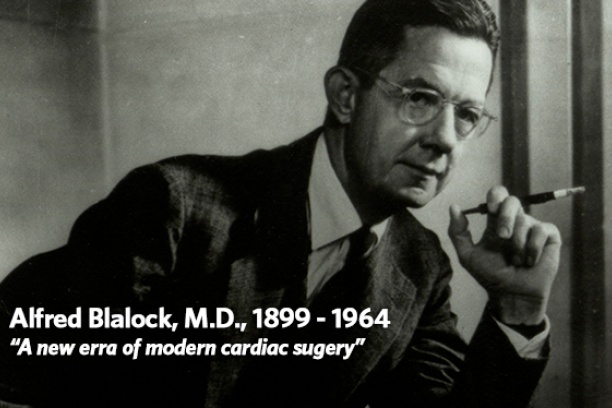
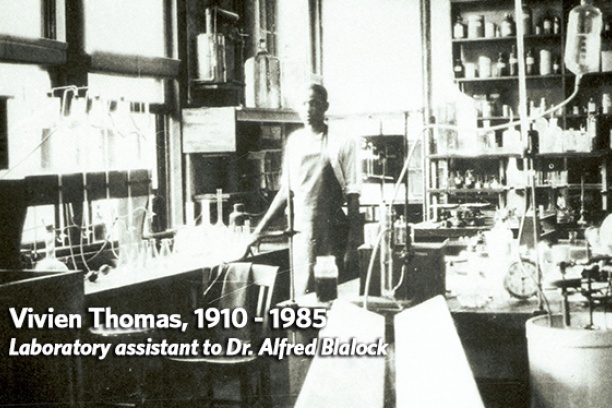
Cardiac surgery at Vanderbilt has had a long and distinguished tradition led by visionary leaders in American surgery. In 1925, Dr. Alfred Blalock began his career at Vanderbilt as Chief Resident in Surgery. After joining the faculty, he then ran the Thoracic Surgery service until his departure in 1941, when he was recruited back to Johns Hopkins. Prior to his departure he ligated an infected patent ductus in 1940 and made seminal contributions to our understanding of shock. He also undertook many of the experiments that led subsequently to the creation of the Blalock-Taussig shunt. That procedure, with its experimental underpinnings having been carried out at Vanderbilt, ushered in the era of modern cardiac surgery.
Following Blalocks return to Baltimore, the Thoracic Surgery service was run by Dr. Rollin Daniels, Jr., and cardiac surgery had its beginnings under the leadership of Dr. H. William Scott.
In 1971, Dr. Harvey Bender was recruited from Johns Hopkins to become Chief of the Division of Thoracic and Cardiac Surgery, developing both the adult and importantly the pediatric cardiac programs. His 27-year career at Vanderbilt was marked by the maturation of the residency in cardiothoracic surgery and important contributions in congenital heart surgery, further growth in adult heart surgery, the development of the heart and lung transplant and mechanical support programs, and the development of a training program in cardiovascular perfusion.
In 1996 Dr. Davis Drinkwater was recruited from UCLA to be the Chief of the Department of Thoracic and Cardiac Surgery. His tenure at Vanderbilt solidified the thoracic transplant programs and experimental cardiac surgical laboratory.
On Jan. 1, 2004, the Department of Cardiac and Thoracic Surgery divided to form the Department of Cardiac Surgery and the Department of Thoracic Surgery. The restructuring lays groundwork for growth in research and patient care, and will aid further enrichment of undergraduate and graduate surgical education, said Dr. R. Daniel Beauchamp, J.C. Foshee Distinguished Professor and chair of the Section of Surgical Sciences.
In a major effort to further develop the cardiovascular service line, Dr. John Byrne was recruited from Brigham and Womens Hospital in Boston to be the next Chair in Cardiac Surgery. Under his leadership, the Vanderbilt Heart and Vascular Institute was created and began a period of rapid clinical growth in cardiac surgical volumes and faculty recruitment. The percutaneous structural heart program began during this period.
In 2012, Dr. Michael Petracek assumed the role of chair of the Department of Cardiac Surgery and Cornelius Vanderbilt Professor of Surgery. During his greater than 30-year career as a cardiac surgeon in Nashville, Dr. Petracek pioneered minimally invasive mitral valve surgery and started the pulmonary endarterectomy program.
Dr. Ashish Shah joined Vanderbilt in 2015 after a decade at Johns Hopkins, where he served in key roles such as Surgical Director for the Lung Transplant, Heart Transplant, and Mechanical Support Programs. In 2017, he assumed his current role as the Alfred Blalock Endowed Director and Chairman of the Department of Cardiac Surgery. Under his visionary leadership, Vanderbilt has significantly expanded its heart transplant, mechanical circulatory support, and Aortic Center programs. By 2025, Vanderbilt University Medical Center achieved a remarkable milestone, becoming the largest heart transplant program in the world.